 Max Glenister
A menu and state system
I’ve been playing with state systems lately, and decided to build a menu system to play with going between each state.
First of all, my helper functions… I’m using this to print outlined text:
-- print text with an outline
function printo(str,x,y,c1,c2)
 for xoff=-1,1 do
  for yoff=-1,1 do
    print(str,x+xoff,y+yoff,c1)
  end
 end
 print(str,x,y,c2)
end
The menu function has two modes, one for running in _update() and one for running in _draw(), you control this by passing "u" or "d" as the second argument.
The first agument takes a table containing a menu definition. I’ll talk more about this with an example after the wall of code:
function menu(m, mode)
 local ic=#m.items
 if mode == "u" then
  if btnp(2) then
   -- up
   m.selection -= 1
   if m.selection < 1 then
    m.selection = 1
   end
  end
  if btnp(3) then
   -- down
   m.selection += 1
   if m.selection > ic then
    m.selection = ic
   end
  end
  if btnp(5) then
   -- x
   if m.items[m.selection][2] then
    m.items[m.selection][2]()
   end
  end
 end
 if mode == "d" then
  local padding={4,4,0,6}-- t/r/b/l
  local lineheight=8
  -- find longest string
  local widest_str=0
  for i,item in pairs(m.items) do
   if #item[1] > widest_str then
    widest_str = #item[1]
   end
  end
  local width = (widest_str*4)+padding[2]+padding[4]
  local height = (ic*lineheight)+padding[1]+padding[3]
  local xoff = 64 - (width/2)
  local yoff = 64 - (height/2)
  local x0 = xoff
  local y0 = yoff
  local x1 = xoff + width
  local y1 = yoff + height
  -- box
  rect(x0-2,y0+1,x1+2,y1+2, 5)
  rect(x0-1,y0-1,x1+1,y1+1,0)
  rectfill(x0,y0,x1,y1,1)
  rect(x0,y0,x1,y1,7)
  -- aditional text
  if m.guide then
   local _w = #m.guide*4
   local _x = 64 - (_w/2)
   local _y = y1+padding[1]+2
   printo(m.guide,_x,_y, 0, 7)
  end
  -- items
  for i,item in pairs(m.items) do
   if i == m.selection then
    -- selection highlight
    printo(
     item[1],
     xoff+padding[4],
     yoff+padding[1]+((i-1)*lineheight),
     0,7
    )
    if m.items[m.selection][2] then
     palt(0,false)
     palt(1,true)
     local xadj=(5 - time()%3)
     spr(1,x0-xadj,y0+padding[1]+((i-1)*lineheight) - 1)
     pal()
    end
   else
    -- normal item
    printo(
     item[1],
     xoff+padding[4],
     yoff+padding[1]+((i-1)*lineheight),
     0,6
    )
   end
  end
 end
end
There’s a lot going on there, but it’s basically maintain a counter for the user’s current selection, and then if there is a function associated with a menu item call it when the x button is pressed.
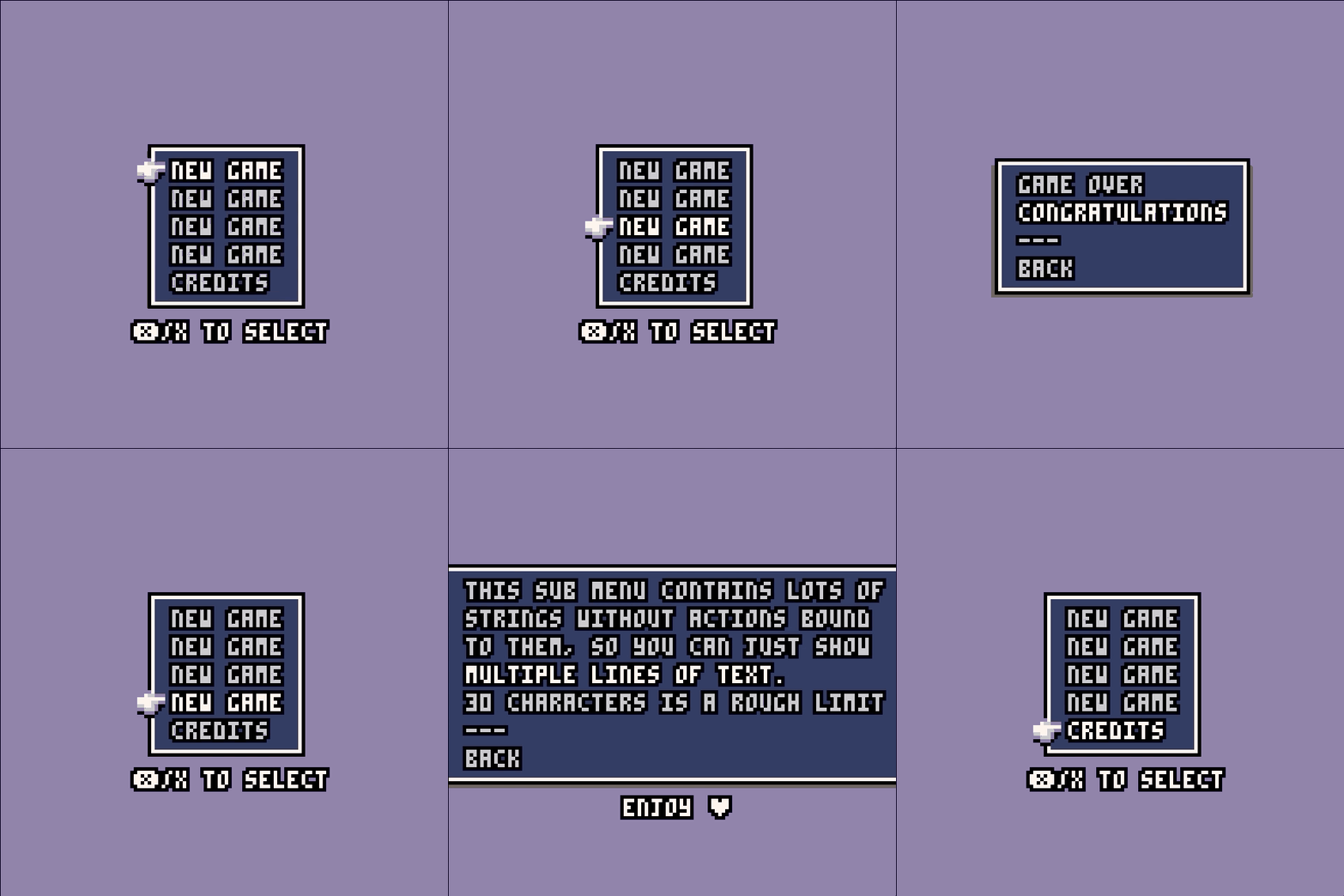
Here’s how the menu definitions look
_menu_start = {
  selection = 1,
  items = {
   {"new game", game},
   {"new game", game},
   {"new game", game},
   {"new game", game},
   {"credits", credits}
  },
  guide="❎ to select"
}

_menu_game = {
  selection = 1,
  items = {
   {"game over", die},
   {"congratulations", win},
   {"---"},
   {"back", start}
  }
}

_menu_credits = {
  selection = 1,
  items = {
   {"this sub menu contains lots of"},
   {"strings without actions bound "},
   {"to them, so you can just show "},
   {"multiple lines of text."},
   {"30 characters is a rough limit"},
   {"---"},
   {"back", start}
  },
  guide="enjoy ♥"
}
You can go between menus using a state system. Here’s the barebones of a state system. We assign a new function to _upd() and _drw() each time the state changes.
function _init()
  start() -- defined later
end

--update
function _update()
 _upd()
end

function update_start()
 menu(_menu_start, "u")
end
function update_game()
 menu(_menu_game, "u")
end
function update_credits()
 menu(_menu_credits, "u")
end

--draw
function _draw()
 cls(13)
 _drw()
end

function draw_start()
 menu(_menu_start, "d")
end
function draw_game()
 menu(_menu_game, "d")
end
function draw_credits()
 menu(_menu_credits, "d")
end

-- functions that are called directly
-- through menu selections

function start()
 _upd=update_start
 _drw=draw_start
end
function game()
 _upd=update_game
 _drw=draw_game
end
function credits()
 _upd=update_credits
 _drw=draw_credits
end
And here’s how it looks in action. I’ve got a custom sprite for the selection hand drawn in sprite slot 1: